


Post-2023 Elections, Nigeria’s electoral system was facing a crisis of confidence. The fallout from the 2023 general elections, particularly controversies surrounding result transmission, logistical failures, and so called “technical glitches,” had left many Nigerians questioning whether their votes truly counted.
As deliberations on the Electoral Act began in the 10th National Assembly, fears grew that rather than fixing the weaknesses exposed in 2023, lawmakers were preparing to preserve them. Discussions around reducing election preparation timelines, weakening accountability mechanisms, and retaining discretionary loopholes in result transmission raised serious concerns among citizens and civil society groups.
For AdvoKC Foundation, silence was never an option. AdvoKC recognised early that the battle for credible elections would not only be fought at polling units in 2027, but in the wording of the law itself. The organisation therefore launched one of its most sustained civic accountability campaigns, focused on ensuring that the National Assembly fulfilled its own legislative promise to “Amend the Electoral Act (2022) to fix identified gaps from the 2023 elections.”
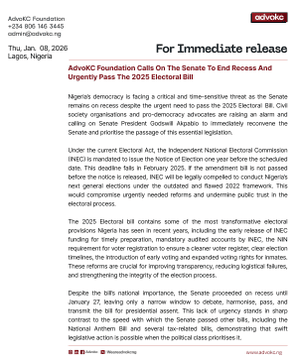
One of the defining moments in the reform process came in December, when the Senate failed to consider the Electoral Bill despite it being listed for presentation and consideration on the Order Paper. Rather than treating the bill with urgency, the Senate proceeded on an end of year recess that lasted more than a month.
This development alarmed AdvoKC Foundation. At the time, concerns were already mounting over shrinking timelines ahead of the 2027 general elections. The Independent National Electoral Commission (INEC) is legally required to issue election notices well ahead of elections, meaning delays in passing the Electoral Act risked creating uncertainty around the legal framework that would govern the next election cycle.
AdvoKC Foundation immediately launched a public campaign urging the Senate to cut short its recess and urgently pass the Electoral Bill. Through press releases, social media campaigns, media engagements, and direct citizen mobilisation, the organisation consistently warned that democracy could not afford legislative complacency on such a time sensitive issue. In response to the growing public outcry, Senate President Godswill Akpabio publicly assured Nigerians, through his advisers, that the Electoral Act would be passed in time for the 2027 elections.



The pressure quickly gained national attention; what began as a focused civic campaign soon evolved into a national conversation. Civil society organisations, media outfits, influencers, content creators, civic actors, ordinary Nigerians, and prominent political figures including Atiku Abubakar amplified the call for urgent electoral reform. Sustained public pressure ensured that the issue could no longer remain buried within legislative procedure or committee deliberations.


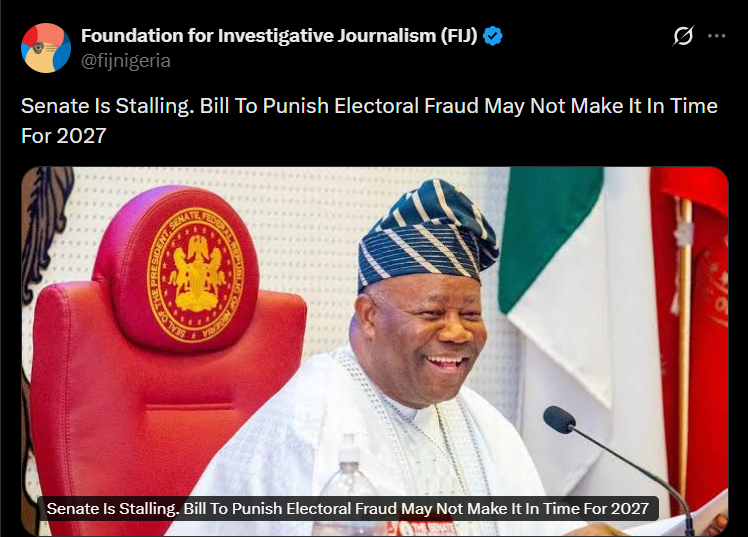
For weeks, electoral reform dominated public discourse across digital spaces, media platforms, and civic conversations. The campaign rested on three key pillars: public education, citizen mobilisation, and direct legislative pressure.
One of the campaign’s biggest achievements was transforming a highly technical legislative process into a public issue that ordinary Nigerians could follow and engage with. Through explainer videos, infographics, X Spaces, press releases, interviews, WhatsApp campaigns, and recurring “Promise of the Week” content, AdvoKC simplified complex electoral reform issues into relatable civic conversations. Rather than speaking only in legal language, the organisation framed the debate around practical questions citizens cared about.


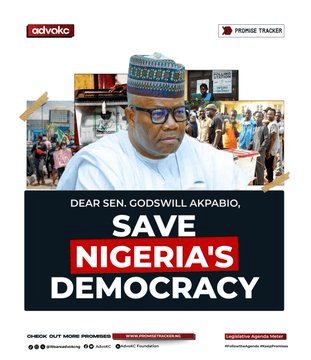

This shift helped citizens understand that electoral reform was not an abstract parliamentary exercise but a direct determinant of whether their votes would count in 2027.
AdvoKC’s campaign was not built on outrage alone. It was grounded in evidence. We consistently highlighted the contradiction at the heart of Nigeria’s democracy: millions of Nigerians still intended to vote, but public confidence in the system remained dangerously low. This data became a central advocacy tool. It allowed AdvoKC to move conversations beyond partisan arguments and place lawmakers under measurable public pressure. Electoral reform was framed not as a political preference but as a democratic necessity.
To make the campaign more relatable and engaging, AdvoKC introduced creative advocacy initiatives that connected with citizens emotionally and politically.
As concerns mounted over attempts to dilute reforms, AdvoKC escalated public pressure through the “Occupy NASS” campaign, combining digital mobilisation with ongoing physical protest actions. Citizens were encouraged to contact lawmakers directly, follow harmonisation proceedings, and publicly demand stronger reforms.
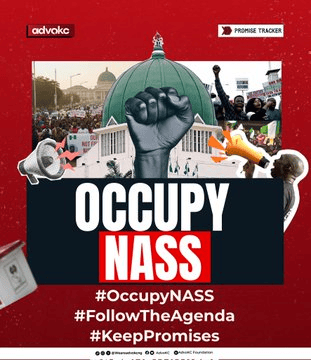

The campaign generated widespread online engagement and forced electoral reform into mainstream public discourse, appearing as one of the most talked about topics on X (formerly Twitter) on multiple occasions. More importantly, it signalled to lawmakers that Nigerians were watching the process in real time.




The defining issue of the reform process became the electronic transmission of election results. Initially, the Senate rejected mandatory electronic transmission and retained the broad discretionary language that had triggered controversy during the 2023 elections. AdvoKC Foundation responded forcefully, describing the move as a betrayal of the National Assembly’s own reform promises.
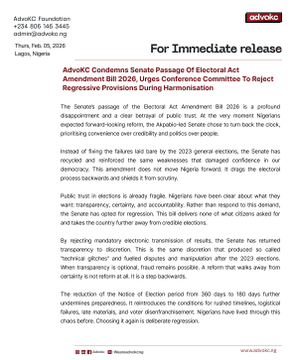

Through sustained advocacy, public statements, media appearances, and coordinated citizen pressure, the organisation helped build momentum against the Senate’s position. Shortly afterwards, during an emergency plenary session, the Senate reversed its position and approved a revised clause making electronic transmission compulsory.
Although the final law retained a fallback provision allowing physical result sheets to become the primary source of collation in cases of communication failure, the reversal itself represented a significant civic victory. It demonstrated that organised public pressure could influence legislative outcomes, even at the highest levels of government.
As the House and Senate moved into harmonisation, AdvoKC continued to intensify engagement with lawmakers. We publicly tracked members of the Conference Committee, educated citizens on the harmonisation process, and urged the committee to adopt the stronger House of Representatives version of the bill. Particular attention was placed on Senator Simon Bako Lalong, sponsor of the original Senate reform bill and Chairman of the Senate Conference Committee. AdvoKC repeatedly argued that the House version more closely reflected the stronger reform vision originally proposed before key provisions were watered down during Senate deliberations.
While the Electoral Act 2026 ultimately fell short of the comprehensive reform many Nigerians hoped for, the advocacy campaign achieved several important outcomes.
AdvoKC’s sustained pressure contributed to the codification of electronic transmission and digital electoral tools into statutory law, wider public awareness of how electoral laws shape election outcomes, increased scrutiny of legislative processes that are usually hidden from public attention, stronger national conversations around electoral integrity and voter protection, preservation of a 300 day election notice period despite attempts to reduce timelines more drastically, and greater citizen participation in legislative accountability processes
Perhaps most importantly, the campaign ensured that the National Assembly could no longer deliberate on electoral reform entirely outside public scrutiny. The Electoral Act 2026 is not a perfect law. Important concerns remain, particularly around the manual fallback provision for result collation. But the process revealed something equally important: Nigerian citizens are no longer passive observers of democracy.
Through this campaign, AdvoKC Foundation helped build a growing community of informed and engaged citizens who now understand the mechanics, loopholes, and implications of electoral legislation.
The organisation did not simply advocate for a bill. It helped create a culture of civic vigilance.
In the end, the most important reform may not have been written into the law itself. It may have been the emergence of a generation of Nigerians who now understand that democracy is not defended every four years at the ballot box alone, but every day through sustained public accountability.
Nigeria belongs to those who show up.
