

.png)
When the 10th Senate of the Federal Republic of Nigeria unveiled its Legislative Agenda for 2023 to 2027, it positioned the document as a roadmap for governance reform, transparency, and national development. Under Agenda 6, focused on social and cultural development, the Senate acknowledged the deep challenges within Nigeria’s healthcare system and made a specific commitment to improve access to healthcare by amending the National Health Act to increase funding for the Basic Health Care Provision Fund (BHCPF) from 1% to at least 2% of the Consolidated Revenue Fund. For many Nigerians, this was a potential lifeline.
At AdvoKC Foundation, we understood that legislative promises often disappear once the headlines fade. That reality informed the creation of the Legislative Agenda Meter (LAM), a specialised accountability tool designed to track measurable commitments made by the National Assembly and subject them to sustained public scrutiny.
By capturing the Senate’s 2% BHCPF commitment on the Legislative Agenda Meter, we transformed it from a statement in a policy document into a live accountability issue. The goal was not simply to record what had been promised, but to monitor whether the promise would actually be fulfilled.
The commitment was prioritised because of its direct impact on ordinary Nigerians. Healthcare remains one of the biggest drivers of poverty in the country, with more than 70% of healthcare expenses paid out-of-pocket. For millions of families, a medical emergency can mean financial ruin. The existing 1% allocation to the BHCPF, introduced in 2014, had also been significantly weakened by inflation over time. Increasing the allocation to 2% represented one of the most practical legislative interventions available to strengthen primary healthcare and improve access for vulnerable communities.
To implement the promise, Senator Ipalibo Banigo sponsored Senate Bill 886, which sought to amend the National Health Act and double BHCPF funding. The bill scaled second reading in October 2025 and was subsequently referred to the Senate Committee on Health, chaired by Senator Banigo herself, with a four-week deadline to report back to the Senate.
That deadline came and went without any report being laid.
Weeks turned into months, with no public communication about the delay surrounding a bill with major implications for healthcare access across the country. Concerned by the silence, AdvoKC began direct advocacy engagement.
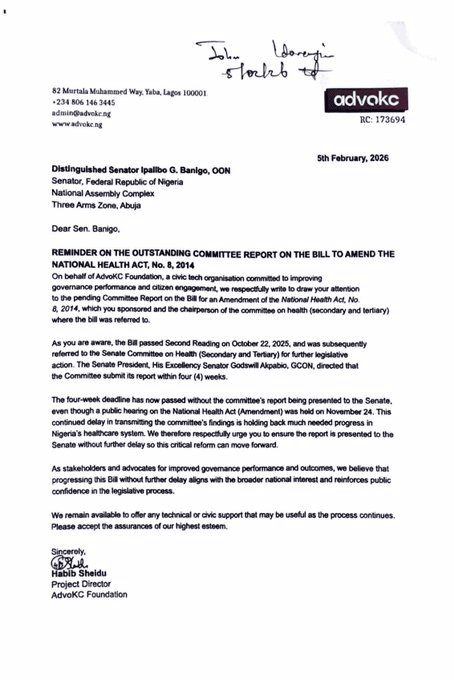
On December 11, 2025, we sent a formal letter to Senator Banigo, reminding her of the committee’s deadline and the urgency of the bill. When there was still no movement, we followed up with 2 other letters on February 5, 2026, addressed to both Senator Banigo and the Senate President, Senator Godswill Akpabio.


Simultaneously, we sustained public pressure through digital advocacy. We produced videos explaining the importance of the BHCPF and what the proposed increase would mean for Nigerians. We published direct appeals urging Senator Banigo to expedite action on the bill and encouraged citizens to demand accountability from their representatives.


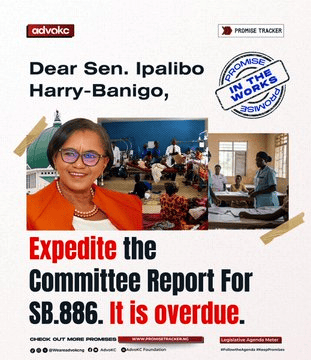
Despite these efforts, the silence continued.
By this point, the original four-week timeline had stretched to nearly six months. It became clear that stronger public pressure was needed.
In response, AdvoKC launched a viral accountability campaign built around a bold visual concept: a “Missing Person” poster featuring Senator Ipalibo Banigo-Harry. The campaign framed the delay as a disappearance of legislative responsibility and sparked widespread public conversation about why a critical healthcare bill had stalled for so long. The pressure quickly produced results.
Shortly after the campaign gained traction, direct communication channels opened with the Senator’s camp. We shared public concerns, presented the broader implications of the delay, and made it clear that the issue would remain in the public eye until action was taken.
The Senate Committee on Health eventually laid its report before the chamber. On April 23, 2026, the Senate officially passed the bill to increase BHCPF funding from 1% to 2%.
The passage of the bill reflected more than legislative progress. It demonstrated the power of sustained civic pressure, strategic communication, and public accountability. It also reinforced the value of the Legislative Agenda Meter as a tool for ensuring that promises made by public institutions are not quietly abandoned.
Following the Senate’s passage of the bill, AdvoKC immediately shifted focus to the House of Representatives. On April 28, 2026, we submitted a formal letter of urgency to the House Leader, Hon. Prof. Julius Ihonvbere, reminding the House that its own Legislative Agenda also contains the same commitment to increase BHCPF funding to 2%.
For perhaps the first time, citizens are tracking a major health reform bill not as a favour from politicians but as an obligation rooted in promises already made to the public.
The work continues until the 2% allocation becomes law.
At AdvoKC, we believe accountability must be pursued consistently and publicly. We talk until something happens.
