

.png)
When the 10th House of Representatives unveiled its Legislative Agenda in 2023, it made a major commitment under its Social Sector Reform priorities: to strengthen basic education in Nigeria by amending the Universal Basic Education Commission (UBEC) Act and increasing UBEC’s share of the Consolidated Revenue Fund.
For millions of Nigerians, this was far more than another policy promise. It represented hope in the middle of a deepening education crisis.
Nigeria currently has more than 10 million out-of-school children, the highest number in the world. Across the country, public primary schools continue to struggle with overcrowded classrooms, inadequate infrastructure, teacher shortages, and insufficient learning materials. Education stakeholders have long argued that the existing funding structure for basic education is no longer adequate for the country’s growing needs.
HB 594, sponsored by Hon. Muktar Tolani Shagaya sought to address this challenge by increasing UBEC’s allocation from 2% to at least 4% of the Consolidated Revenue Fund. However, despite the significance of the bill, it stalled at the committee stage after passing second reading in March 2024. The bill had been referred to the House Committee on Basic Education Services, chaired by Hon. Mark Bako Useni.
At AdvoKC Foundation, we believe legislative agendas should not exist merely as public relations documents. Promises made to citizens should be tracked, measured, and pursued until they are fulfilled.
Through the Legislative Agenda Meter on Promise Tracker NG, we began tracking the House’s commitment to amend the UBEC Act shortly after the Legislative Agenda was launched. When the timeline for delivery elapsed without progress, the promise was classified as “Broken.”
But tracking was only the beginning.
We intensified advocacy around the bill through sustained public awareness campaigns, media engagement, citizen mobilisation, direct legislative engagement, and strategic communication efforts designed to keep attention on the issue.
On September 22, 2025, we sent a formal letter to Hon. Mark Bako Useni, urging immediate action on the bill, which had by then remained stalled for approximately 18 months. We also directly engaged the committee chairman and raised concerns around the need for reforms that would allow states easier access to UBEC funds. During these engagements, he assured us that the committee would expedite work on the bill and address concerns relating to states’ access to funding.
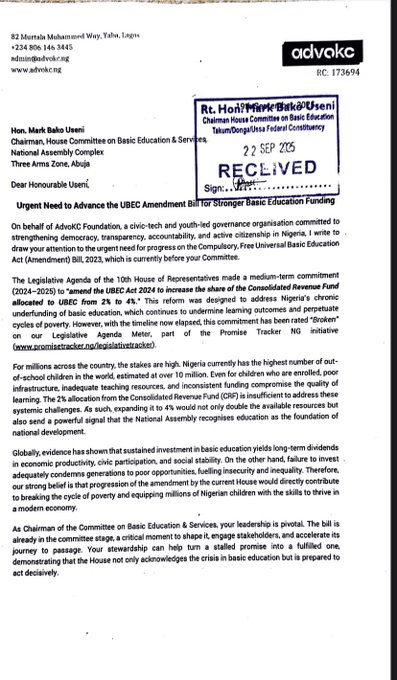
The committee report was eventually laid before the House on October 22, 2025.
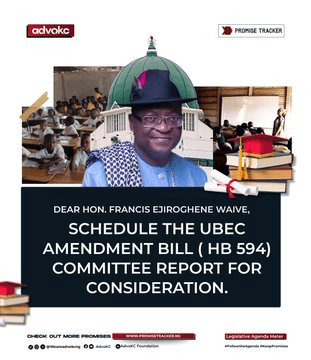
Attention then shifted to securing consideration and third reading of the bill. To sustain momentum, we formally wrote to Hon. Francis Waive, Chairman of the House Committee on Rules and Business, on November 14, 2025, urging the leadership of the House to schedule the bill for consideration and passage without further delay.
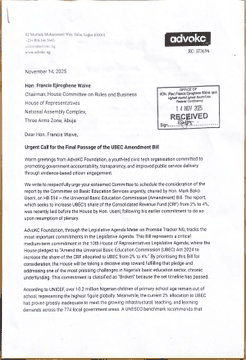
Alongside these direct engagements, we continued public advocacy efforts, consistently calling on Hon. Francis Waive to prioritise the bill while mobilising citizens across Nigeria to call, text, email, and publicly demand action from lawmakers.
The message remained simple and urgent: Nigeria’s children cannot continue to wait.


As the delay persisted, we sustained follow-up engagements with lawmakers and continued public pressure around the bill. On April 28, 2026, we wrote to Hon. Prof. Julius Ihonvbere, Majority Leader of the House of Representatives, urging immediate consideration, third reading, and passage of the amendment bill.
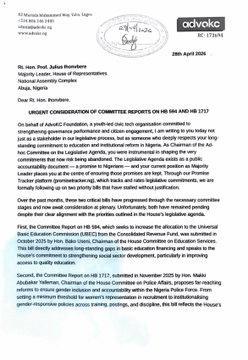
Our consistent advocacy, strategic communication, and legislative follow-up eventually yielded results.
On May 7, 2026, the House of Representatives passed the UBEC Amendment Bill, a landmark reform seeking to increase UBEC’s allocation from 2% to 4% of the Consolidated Revenue Fund.
The passage of the bill marked a major victory for education reform, legislative accountability, and citizen-driven advocacy.
If fully enacted and implemented, the amendment has the potential to improve classroom infrastructure significantly, teacher recruitment and training, learning materials, access to education in underserved communities, and the implementation of Universal Basic Education projects across states.
Beyond its policy impact, the bill’s passage also reinforced an important democratic lesson: citizens can influence governance, legislative promises can be monitored, public pressure works, and accountability mechanisms matter.
It further highlighted the importance of collaboration between citizens, civil society organisations, and lawmakers in addressing national challenges.
Although the House has passed the bill, the process is not yet complete. The legislation must still pass through the remaining legislative and executive stages before it becomes law and begins to impact classrooms across Nigeria.
In continuation of our advocacy, we have written to Senator Michael Opeyemi Bamidele, Majority Leader of the 10th Senate, urging immediate action and passage of the bill in the Senate.
AdvoKC Foundation will continue to track the process, engage stakeholders, and advocate for effective implementation once the amendment is enacted.
Because while passing a bill is important, ensuring it improves the lives of ordinary Nigerians is what truly matters.
